


Exercises to prevent tearing during birth
It is possible to have a vaginal delivery without tearing. Exercise can help prepare your pelvic floor for birth and reduce your risk of tearing. Your pelvic floor needs to be able to relax and stretch for a vaginal delivery to occur. In this post, I’m going to give you a few of my favorite exercises to help your pelvic floor relax and learn how to stretch for birth.
What is the pelvic floor?
The pelvic floor is a group of muscles that forms the bottom of the abdominal canister. Together, they form a hammock to support your bladder, uterus, and rectum. Your pelvic floor muscles also control your openings and stop the flow of pee and poop from coming out.
What happens to the pelvic floor during birth
For a baby to come out effectively, your baby has to get through your vaginal opening. A common misconception is that your pelvic floor is what pushes your baby out, so during pregnancy you should do kegels to strengthen it.
This is actually the exact OPPOSITE of what needs to happen. It is your uterus that dilates your cervix and pushes your baby out, not your pelvic floor. Your baby actually needs to pass through your pelvic floor, meaning your pelvic floor has to not only relax, but stretch 2-3x its resting length. To stretch without injury, it is important to train your pelvic floor to not only relax, but stretch & lengthen under load.
Types of tearing during birth
While technically you can tear in any direction, Perineal tears are the most common tear that occurs during childbirth. These tears occur from the bottom of your vaginal opening and go towards your anal opening.
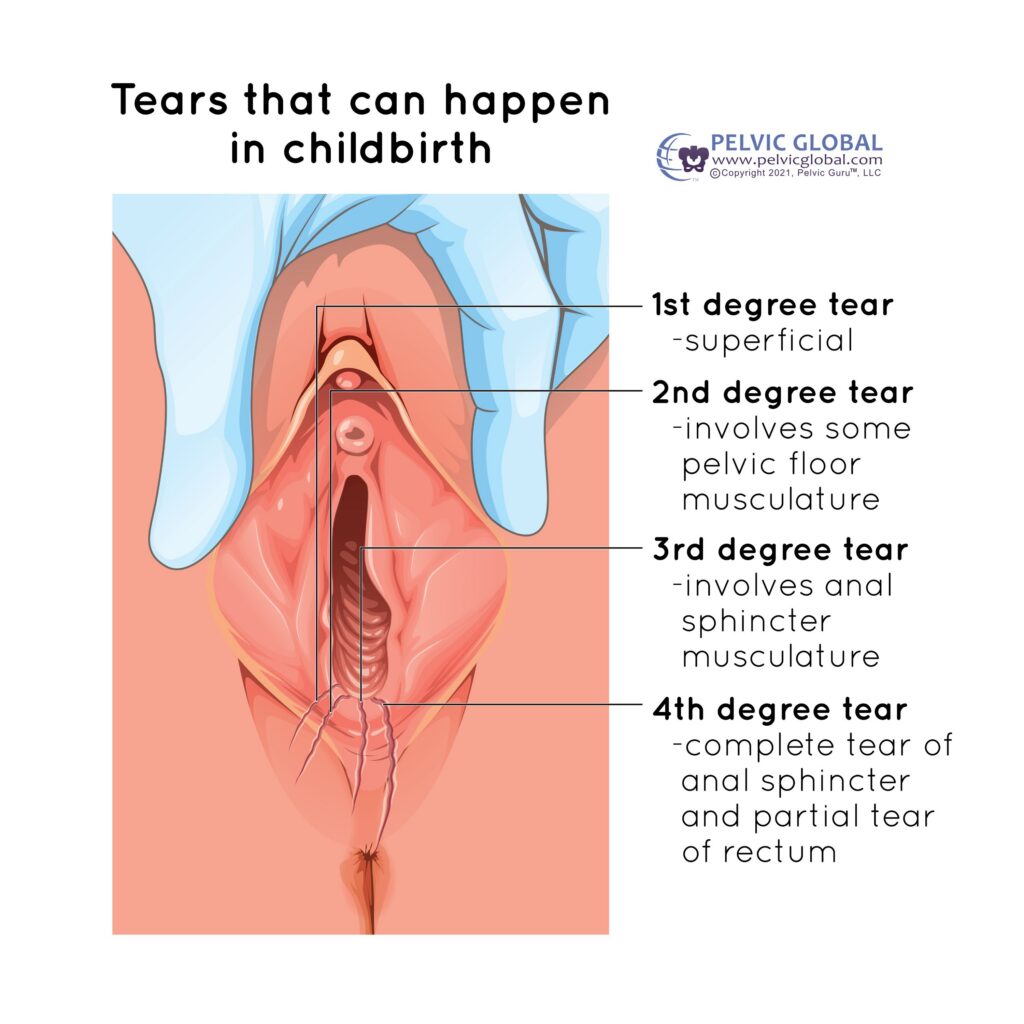
Not all tears are the same. There is a varying degree of tearing that can occur during childbirth.
A grade 1 tear is superficial, typically involving only tissue, not your pelvic floor. These tears may require a stitch or two, but sometimes they can be left alone and heal without sutures.
A grade 2 tear involves some pelvic floor muscle and requires suturing at the bedside.
A grade 3 tear is more severe and extends into the anal sphincter, while a grade 4 tear is the most severe, going through the anal sphincter.
Our primary goal is to decrease the incidence of Grade 3 & 4 perineal tears, as they typically require a repair in the OR and are often followed by a course of antibiotics due to their proximity to the anal sphincter.
Exercises to prevent tearing during birth
Diaphragmatic breathing in child’s pose
This exercise uses breathwork to help the back side of the pelvic floor relax. When performing this exercise, think about trying to breathe all the way down to your butthole, allowing your pelvic floor to relax and open.
Quadruped Hip Shift
This exercise focuses on improving hip internal rotation unilaterally. Unilateral movements in general are a great way to improve pelvic mobility to allow the baby to rotate down through the pelvis during birth. The additional focus on internal rotation helps open the bottom of the pelvis where the baby will come out.
Adductor Thread The Needle
Your pelvic floor can be influenced by both your rib cage above your pelvis and your adductors below your pelvis. If your rib cage can move and your adductors can lengthen and relax, it is a lot easier for your pelvic floor to do the same.
Foot elevated Hip Hinge
This is the standing version of the quadruped hip shift. In addition to improving internal rotation and being an asymmetrical movement, it promotes full glute length and also strength – both of which are important to optimize pelvic floor function to give you support during pregnancy while still improving its ability to lengthen under load.
Pelvic Outlet Rockback
During the pushing phase of labor, your baby needs to pass through the pelvic outlet, or the bottom of your pelvis. Positioning your ankles wider than your knees helps to open your pelvic outlet, allowing easier passage for baby during the pushing phase of labor.
Other interventions to prevent tearing during birth: perineal massage, pushing positions, open glottis pushing, avoiding pain medication
Perineal Massage to prevent tearing during birth
Perineal massage before labor has been shown to decrease severe tearing (3rd and 4th degree tears) in first-time vaginal deliveries. I typically recommend first-time moms and primary VBAC moms start performing perineal massage a few times a week starting at 36 weeks.
Pushing Positions to prevent tearing during birth
Pushing on your back has the highest risk of perineal tearing, likely due to the inability for the sacrum to move. Ideally, you would be able to deliver in hands and knees or on your side (which is also epidural-friendly). If you must deliver on your back, placing a towel roll under the small of your back can give the sacrum a little more space to move.
Open glottis pushing to prevent tearing during birth
Believe it or not, there are fascial connections between your pelvic floor and your throat. Keeping your neck, shoulders, and throat open and relaxed during labor and pushing can help your pelvic floor stay relaxed. The cue I give to the moms I see in the clinic is to: take a big breath into your belly, and then, keeping your mouth open, push your breath out your butthole.
Understanding how to push can be one of the biggest reasons for a long pushing phase, which is why I always offer pushing practice during my one-on-one birth preparation sessions in the clinic.
A note on epidurals during birth
An epidural may be appealing, especially towards the end of labor when everything gets intense. Sometimes an epidural is warranted if a mom is having a difficult time relaxing and labor is not progressing.
For other moms, an epidural can limit the positions you can birth in, increase the need for coached pushing, and allow you to push through the tissues without feeling it, leading to an increased risk of tearing.
When to see a pelvic floor therapist
If you are concerned about tearing during your delivery, it would be best to consult with a pelvic floor therapist to determine your pelvic floor’s ability to relax and stretch. Seeing a pelvic floor therapist to prepare for birth can not only reduce your risk for severe tearing, but it is also associated with decreased labor times and fewer postpartum complications.
Where you can find a pelvic floor therapist who can help you prevent tearing during birth.
At Strength & Dignity Wellness, we offer Birth Preparation appointments for moms in their third trimester that incorporate both manual therapy and exercises to prevent tearing during birth.


Comments will load here
Be the first to comment